
ALGT recently examined a remarkable 4-carat emerald displaying a distinct and well-defined cat’s eye effect.
Using Raman spectroscopy, we first confirmed that the gemstone is indeed a natural emerald. The stone shows a vibrant green color, good transparency, and is polished as a cabochon, a cut style that beautifully highlights its optical phenomenon. Under a single direct light source, the emerald reveals a sharp and mobile chatoyant band centered across the surface, a striking cat’s-eye effect rarely seen in emeralds.
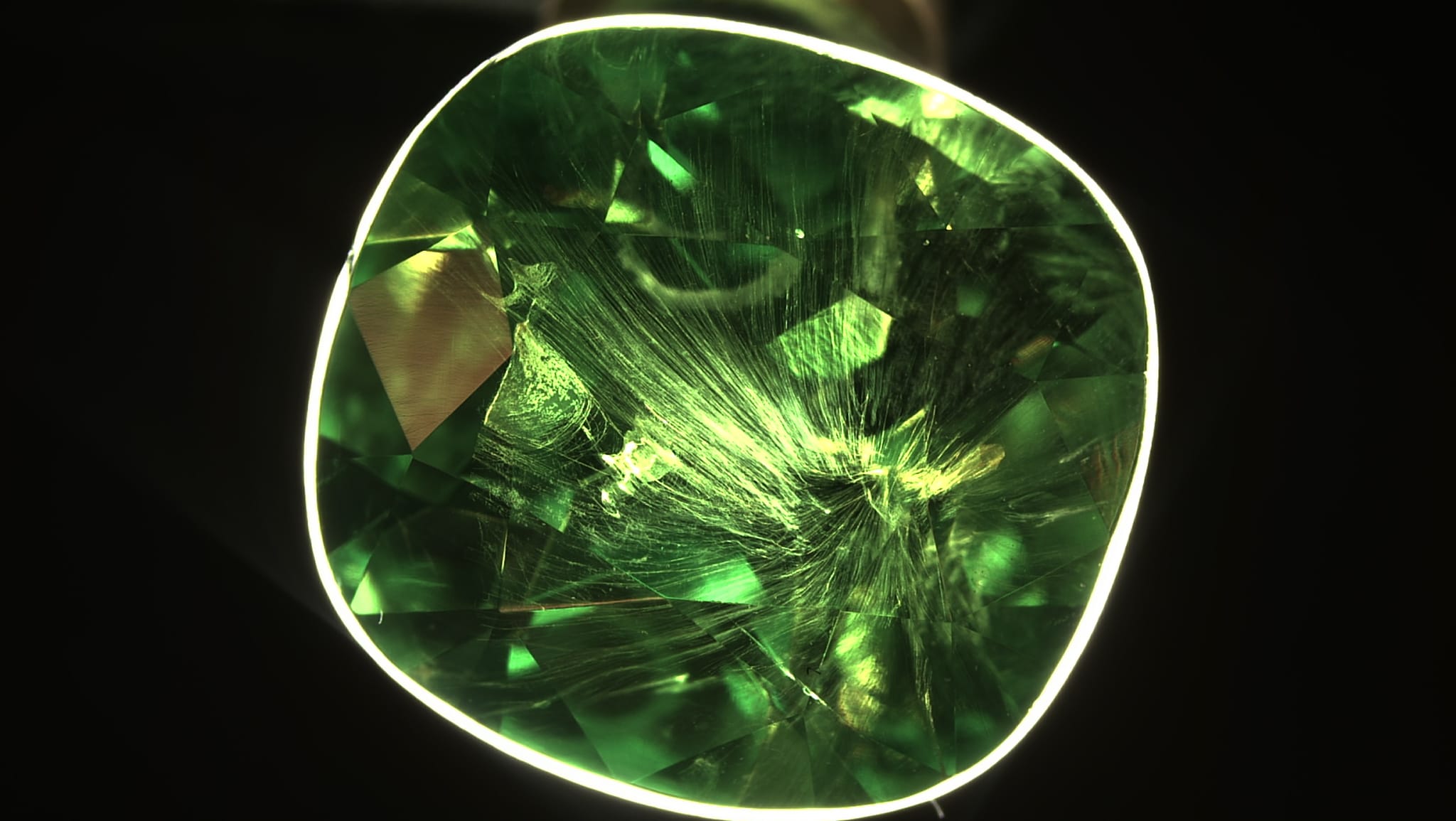
Under magnification, we observed numerous parallel elongated tube-like inclusions. These well oriented inclusions are responsible for the gemstone’s exceptional chatoyancy.
To investigate possible clarity enhancement, the emerald was examined under long-wave UV light (365 nm). No anomalous fluorescence zones were observed, indicating the absence of residual oil or resin. In emeralds which have undergone the clarity enhancement, such fillers often produce noticeable yellowish-green or bluish-white fluorescence.
For further confirmation, FTIR analysis was carried out. In the 2800–3100 cm⁻¹ region, no absorption peaks related to oils or resins were detected. The absence of clarity-enhancing substances in a cabochon-cut emerald is particularly unusual and noteworthy.
The UV-Vis spectrum revealed characteristic Cr³⁺ absorption features, including a strong band near 430 nm and a broad band near 600 nm, confirming the emerald’s color origin. In addition, a distinct Fe²⁺ absorption band near 850 nm indicates a relatively high iron content.
Finally, EDXRF analysis, together with the spectroscopic and microscopic results, supported the conclusion that this emerald is of Brazilian origin.
A fascinating example of how advanced gemological testing can reveal both the beauty and the story behind an extraordinary gemstone.
Using Raman spectroscopy, we first confirmed that the gemstone is indeed a natural emerald. The stone shows a vibrant green color, good transparency, and is polished as a cabochon, a cut style that beautifully highlights its optical phenomenon. Under a single direct light source, the emerald reveals a sharp and mobile chatoyant band centered across the surface, a striking cat’s-eye effect rarely seen in emeralds.
Under magnification, we observed numerous parallel elongated tube-like inclusions. These well oriented inclusions are responsible for the gemstone’s exceptional chatoyancy.
To investigate possible clarity enhancement, the emerald was examined under long-wave UV light (365 nm). No anomalous fluorescence zones were observed, indicating the absence of residual oil or resin. In emeralds which have undergone the clarity enhancement, such fillers often produce noticeable yellowish-green or bluish-white fluorescence.
For further confirmation, FTIR analysis was carried out. In the 2800–3100 cm⁻¹ region, no absorption peaks related to oils or resins were detected. The absence of clarity-enhancing substances in a cabochon-cut emerald is particularly unusual and noteworthy.
The UV-Vis spectrum revealed characteristic Cr³⁺ absorption features, including a strong band near 430 nm and a broad band near 600 nm, confirming the emerald’s color origin. In addition, a distinct Fe²⁺ absorption band near 850 nm indicates a relatively high iron content.
Finally, EDXRF analysis, together with the spectroscopic and microscopic results, supported the conclusion that this emerald is of Brazilian origin.
A fascinating example of how advanced gemological testing can reveal both the beauty and the story behind an extraordinary gemstone.
Gallery
Click any image to enlarge