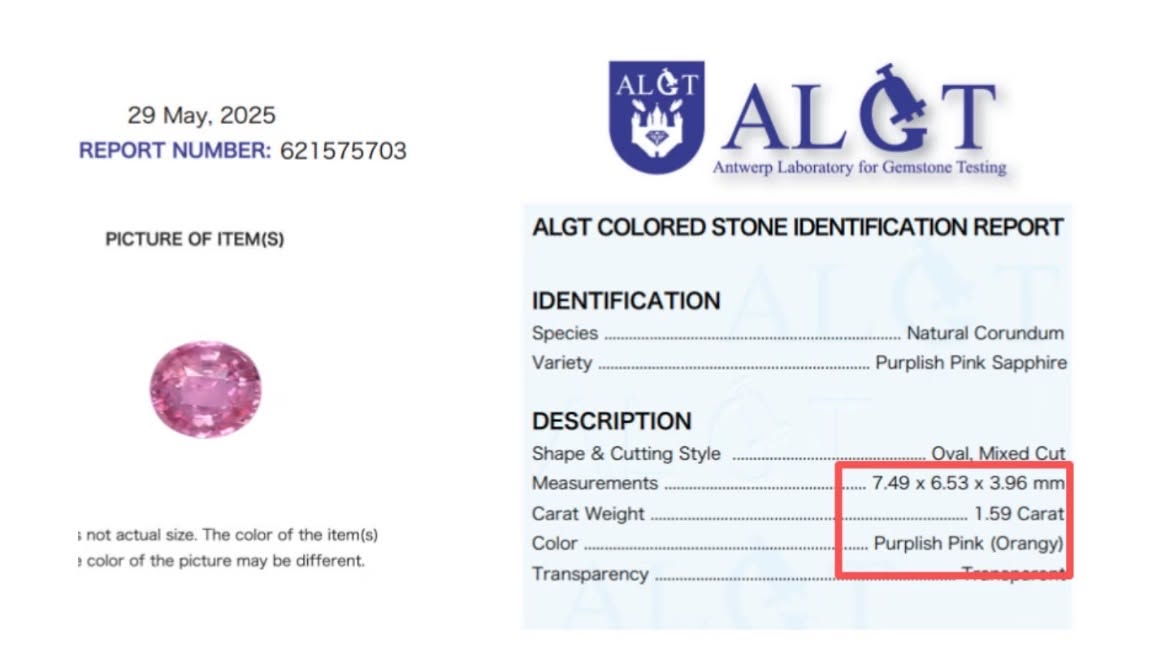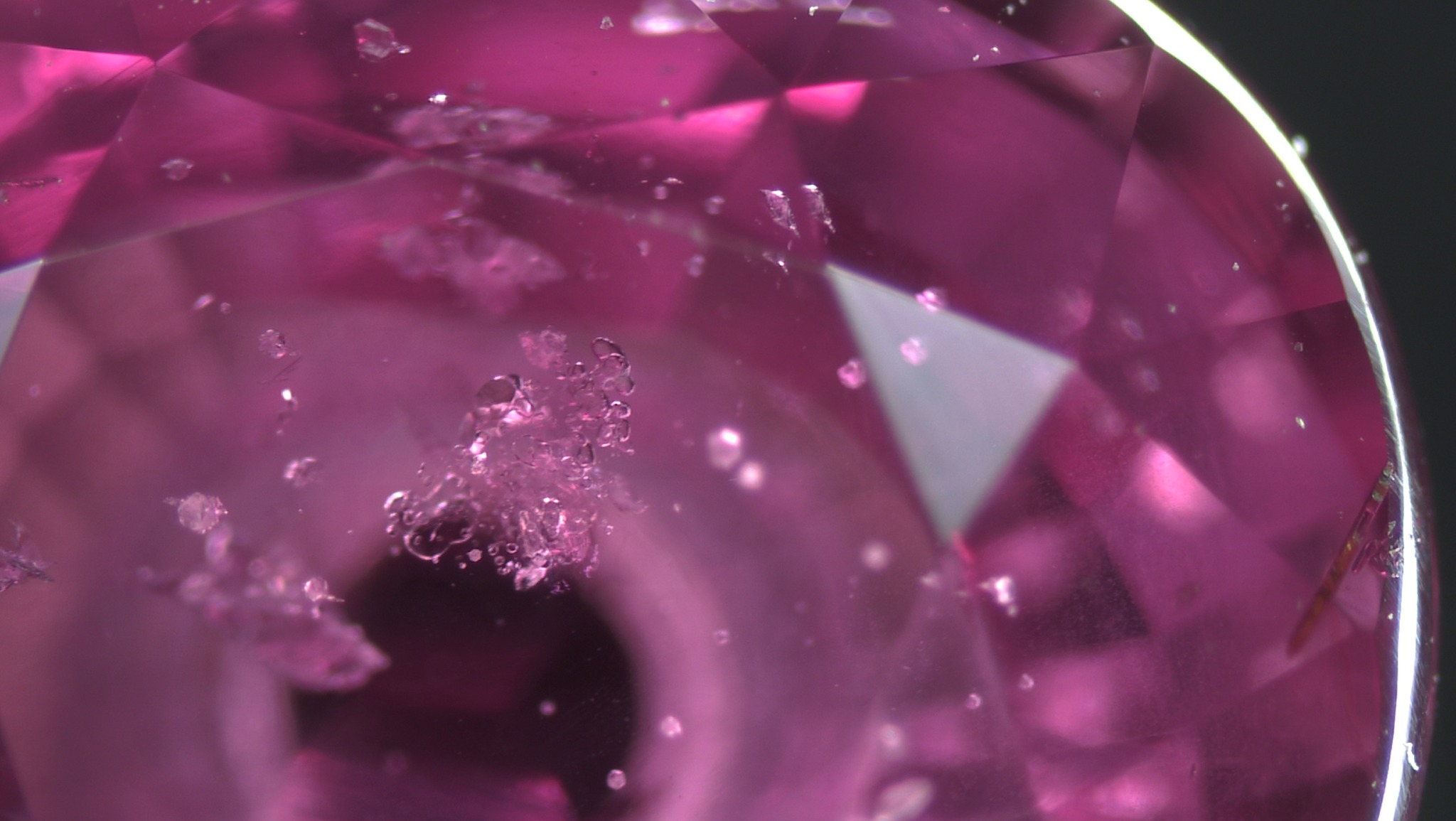

Recently, ALGT received a bluish green gemstone weighing over 30 ct. The client submitted the stone as an emerald; however, after examination, the Antwerp Laboratory for Gemstone Testing reached a different conclusion.
Gem identification
We first performed Raman spectroscopy to identify the material, and the results confirmed that the stone belongs to the beryl group.
Visually, the gemstone displays a very light bluish green colour. Some organisations distinguish emerald from the less valuable “green beryl” mainly based on colour tone and saturation, meaning that if the green colour is too light, the stone may be classified as green beryl rather than emerald.
At ALGT, we follow the LMHC definition of emerald, which states:
“Emerald is a beryl mainly coloured by chromium and/or vanadium showing a medium to strong green saturation. If the greenish colour in an iron-rich beryl is only related to low traces of chromium, then the stone is considered a green beryl and not an emerald.” (LMHC Information Sheet #5 Emerald, LMHC Standardised Gemmological Report Wording, version 6; May 2025)
Because chromium is the key colouring element in emerald, understanding its role is essential. Chromium is relatively rare in nature, yet it is responsible for the remarkable colours in many gemstones such as ruby, emerald, alexandrite, tsavorite, demantoid, spinel, and others. Through isomorphous substitution, chromium ions can replace other metal ions in a crystal structure, changing the gemstone’s absorption behaviour and therefore its perceived colour.
UV-Vis-NIR spectroscopy
The stone was then analysed by UV-Vis-NIR spectroscopy to evaluate its absorption behaviour in the spectral range from 365 nm to 1000 nm.
The spectrum is strongly dominated by an iron-related absorption band centred in the near-infrared, while only very weak chromium-related absorption bands appear in the visible region. These small chromium features contribute only slightly to the colour, resulting in a light green to bluish green appearance.
This absorption behaviour is not consistent with emerald, which typically shows distinct chromium (and/or vanadium) absorption features and a medium to strong green saturation.
Comparison with light-coloured emeralds
At ALGT, we have observed light green emeralds, especially from Colombia, which may show relatively low colour saturation. However, when tested by UV-Vis-NIR spectroscopy, these stones still display distinct chromium-related absorption bands, usually with very limited iron influence.
We have also examined light green emeralds from Nigeria, which can contain a higher concentration of iron. In such cases, the UV-Vis-NIR spectrum often shows a noticeable iron-related absorption band, but importantly, the chromium absorption is still clearly present. For these borderline stones, chemical analysis becomes necessary to support the final classification.
EDXRF chemical analysis and Fe/Cr ratio
To confirm the nature of the colouring elements in this 30 ct stone, we performed EDXRF chemical analysis. The results revealed:
Iron (Fe): 5727 ppm
Chromium (Cr): 128.3 ppm
Fe/Cr ratio = 44.64
This value is significantly higher than the Fe/Cr ratio typically observed in emerald. According to the SSEF publication Colour varieties of gems – where to set the boundary? (Dr. M.S. Krzemnicki, Facette 26, May 2020), emeralds are generally chromium-dominated, with Fe/Cr ratios below 10, while many light green to bluish green beryls are characterised by low chromium and high iron, resulting in Fe/Cr ratios above 10, and in some cases exceeding 100.
Conclusion
Based on the combined results of Raman spectroscopy, UV-Vis-NIR spectroscopy, and EDXRF chemical analysis, we conclude that the gemstone is classified as a Green beryl rather than an emerald.
Gem identification
We first performed Raman spectroscopy to identify the material, and the results confirmed that the stone belongs to the beryl group.
Visually, the gemstone displays a very light bluish green colour. Some organisations distinguish emerald from the less valuable “green beryl” mainly based on colour tone and saturation, meaning that if the green colour is too light, the stone may be classified as green beryl rather than emerald.
At ALGT, we follow the LMHC definition of emerald, which states:
“Emerald is a beryl mainly coloured by chromium and/or vanadium showing a medium to strong green saturation. If the greenish colour in an iron-rich beryl is only related to low traces of chromium, then the stone is considered a green beryl and not an emerald.” (LMHC Information Sheet #5 Emerald, LMHC Standardised Gemmological Report Wording, version 6; May 2025)
Because chromium is the key colouring element in emerald, understanding its role is essential. Chromium is relatively rare in nature, yet it is responsible for the remarkable colours in many gemstones such as ruby, emerald, alexandrite, tsavorite, demantoid, spinel, and others. Through isomorphous substitution, chromium ions can replace other metal ions in a crystal structure, changing the gemstone’s absorption behaviour and therefore its perceived colour.
UV-Vis-NIR spectroscopy
The stone was then analysed by UV-Vis-NIR spectroscopy to evaluate its absorption behaviour in the spectral range from 365 nm to 1000 nm.
The spectrum is strongly dominated by an iron-related absorption band centred in the near-infrared, while only very weak chromium-related absorption bands appear in the visible region. These small chromium features contribute only slightly to the colour, resulting in a light green to bluish green appearance.
This absorption behaviour is not consistent with emerald, which typically shows distinct chromium (and/or vanadium) absorption features and a medium to strong green saturation.
Comparison with light-coloured emeralds
At ALGT, we have observed light green emeralds, especially from Colombia, which may show relatively low colour saturation. However, when tested by UV-Vis-NIR spectroscopy, these stones still display distinct chromium-related absorption bands, usually with very limited iron influence.
We have also examined light green emeralds from Nigeria, which can contain a higher concentration of iron. In such cases, the UV-Vis-NIR spectrum often shows a noticeable iron-related absorption band, but importantly, the chromium absorption is still clearly present. For these borderline stones, chemical analysis becomes necessary to support the final classification.
EDXRF chemical analysis and Fe/Cr ratio
To confirm the nature of the colouring elements in this 30 ct stone, we performed EDXRF chemical analysis. The results revealed:
Iron (Fe): 5727 ppm
Chromium (Cr): 128.3 ppm
Fe/Cr ratio = 44.64
This value is significantly higher than the Fe/Cr ratio typically observed in emerald. According to the SSEF publication Colour varieties of gems – where to set the boundary? (Dr. M.S. Krzemnicki, Facette 26, May 2020), emeralds are generally chromium-dominated, with Fe/Cr ratios below 10, while many light green to bluish green beryls are characterised by low chromium and high iron, resulting in Fe/Cr ratios above 10, and in some cases exceeding 100.
Conclusion
Based on the combined results of Raman spectroscopy, UV-Vis-NIR spectroscopy, and EDXRF chemical analysis, we conclude that the gemstone is classified as a Green beryl rather than an emerald.
Gallery
Click any image to enlarge